
Some rooms introduce us before we have the chance to speak.
We tend to think photographs decorate a space.
They add colour. Balance. Interest.
But long before conversation begins, something quieter is already happening.
The images on our walls are speaking.
Not loudly. Not deliberately. But unmistakably. They suggest what we notice, what we value, and how we move through the world. A visitor may not consciously analyse them, yet the feeling of a room is shaped long before words arrive.
A home does not begin with conversation.
It begins with atmosphere.
And photographs play a larger role in that atmosphere than we often realise.
The Invisible Introduction
When we enter someone else’s home, we read it instinctively.
We notice light. Space. Objects. But photographs hold a particular weight because they are chosen rather than necessary. A chair serves a function. A photograph reveals preference.
Some homes feel energetic. Others reflective. Some feel carefully curated, while others feel quietly lived in.
Often, the difference is not design.
It is intention.
Photographs can signal ambition, nostalgia, curiosity, calm, or restlessness — sometimes all at once. They communicate orientation rather than status. They tell us how someone relates to the world more than what they own within it.
And often, the person who chose them is only partly aware of what they are saying.
When Images Become Identity
It is easy to begin choosing photographs as expressions of who we believe we are.
Travel images to signal adventure.
Minimal images to signal restraint.
Dramatic images to signal confidence.
There is nothing dishonest in this. We are all trying, in small ways, to understand ourselves and be understood by others.
But something subtle can happen when identity becomes the primary reason for choosing art.
Rooms start to feel curated rather than inhabited.
Images begin explaining instead of accompanying.
And the space grows slightly performative — not uncomfortable enough to notice immediately, but never entirely settled either.
The photographs are speaking loudly, but not always truthfully.
A Photograph That Told Me Something I Didn’t Know
My first visit to Italy surprised me in ways I hadn’t anticipated.
When we arrived at Paestum, I expected to admire the temples in an intellectual way. They were historically important, undeniably impressive, and beautifully preserved. I assumed I would photograph them respectfully and move on, appreciating them more for what they represented than for how they made me feel.
But something unexpected happened once we slowed down.
Away from the movement of the group, I found myself sitting quietly among the ruins. There was no urgency there. The stones did not ask to be understood or explained. They simply existed, unchanged by the passing centuries, indifferent to whether anyone noticed them at all.
As I began photographing, I realised I was not searching for compositions in the usual way. I was lingering. Waiting. Allowing the place to settle rather than trying to capture it quickly.
What surprised me most was the sense of calm that arrived without effort. I had always thought of myself as someone grounded firmly in the present, comfortable with the pace and clarity of modern life. Yet sitting among structures built thousands of years ago, I felt an unexpected peace, as though time itself had softened.
It was the first time I understood that a photograph can reveal something about us that we did not already know.
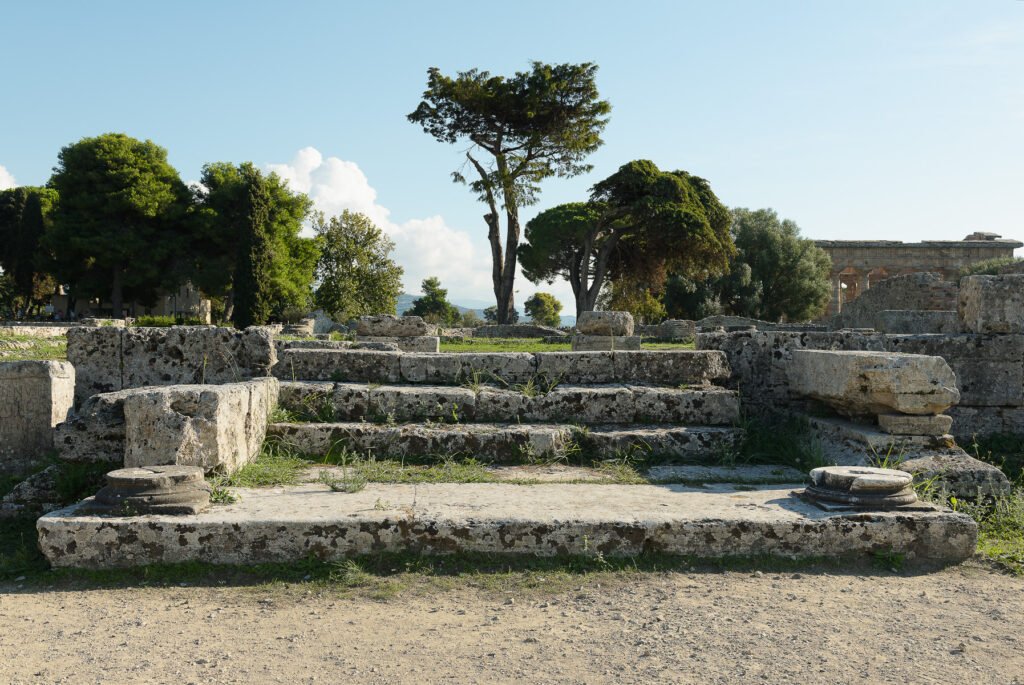
A moment of stillness among ruins that had nothing to prove and nowhere to go.
Looking back at these photographs now, I realise they do more than document a place. They return me to a feeling I did not anticipate — a quiet recognition that not everything meaningful belongs to the present moment.
The ruins did not change who I was. But they gently challenged an assumption I had carried for years: that comfort comes from familiarity. Instead, I discovered that peace can sometimes arrive from encountering something far older than ourselves, something that reminds us how small our urgency really is.
Whenever I revisit these images, I am reminded less of travel and more of that unexpected stillness — the moment I understood that photography is not only about seeing the world differently, but about discovering parts of ourselves we had not yet met.
What Our Walls Quietly Reveal
This is why photographs matter differently from decoration.
They are not only expressions of identity; they are discoveries of it.
Over time, the images we continue to live with tend to align not with who we wish to appear to be, but with who we are becoming. The photographs that remain are rarely the most impressive ones. They are the ones that feel familiar in a deeper sense.
They recognise us.
Visitors may sense this without understanding why. A room feels calm, or thoughtful, or open, or grounded. The effect is subtle but real.
The photographs have already spoken.
A Different Way to Choose
Perhaps the question is not:
What does this photograph say about me?
But:
How do I feel when I live beside it?
The first question produces explanation.
The second produces relationship.
When photographs are chosen for relationship rather than identity, something softens. The room becomes less about presentation and more about presence.
And presence is what people feel most clearly when they enter a space.
Closing Reflection
We rarely introduce ourselves by describing our walls.
Yet our surroundings often speak first.
The photographs we live with do not need to define us or explain us. Over time, they do something quieter and more generous.
They help us recognise ourselves.
And sometimes, long before we understand why, they already know who we are becoming.
I write and create around presence, time, and the quieter ways we live with images. If this resonated, you may find similar reflections in my photography.
Read More Stories Like This:
- A Simple Way to Choose Art That Actually Means Something
- I No Longer Need Every Photograph to Explain Itself
- I Stopped Buying Art to Impress People and Started Buying It to Feel Something