
Not everything that fills a space belongs there.
There was a time when I thought more was better.
More images. More variety. More visual interest. More to look at. I believed a wall should be active, engaging, impressive. I liked the idea of choice. Of options. Of having something for every mood.
It felt generous. It felt creative. It felt alive.
But over time, I started to notice something.
The more I added, the less I felt.
Not dramatically. Not obviously. Just quietly.
The images competed. The space became busy. My eye never settled. Nothing stayed long enough to matter.
And without quite meaning to, I had turned my walls into a kind of visual conversation that never paused.
It took me a while to realise that I was mistaking stimulation for connection.
The Difference Between Noise and Presence
An impressive image gets your attention.
An honest one keeps it.
There is nothing wrong with spectacle. Nothing wrong with scale, colour, drama, or impact. I’ve made those images myself. I admire them. I still do.
But I’ve learned that admiration and attachment are not the same thing.
An impressive photograph can stop you in your tracks.
An honest one stays with you after you’ve walked away.
The difference is subtle, but it matters.
When an image is honest, it doesn’t perform. It doesn’t announce. It doesn’t try to be anything other than what it is. It carries something human. A trace. A truth. A vulnerability that doesn’t need explanation.
Those are the images that settle.
Those are the ones you live with, not just look at.
I’ve had photographs on my walls that people commented on often. They were striking. They were well executed. They were admired.
And yet, when I took them down, I didn’t miss them.
Not really.
But the few images that I have lived with quietly, without fuss, without commentary, without display… those are the ones I notice when they’re gone.
That’s how I know.
What Stays When the Applause Fades
There is a particular kind of image that doesn’t attract attention straight away.
It doesn’t demand.
It doesn’t impress.
It doesn’t show off.
It waits.
At first, you might not even see it. Or you might see it and move on. It doesn’t give you much to react to. It doesn’t offer spectacle. It offers something else.
Recognition.
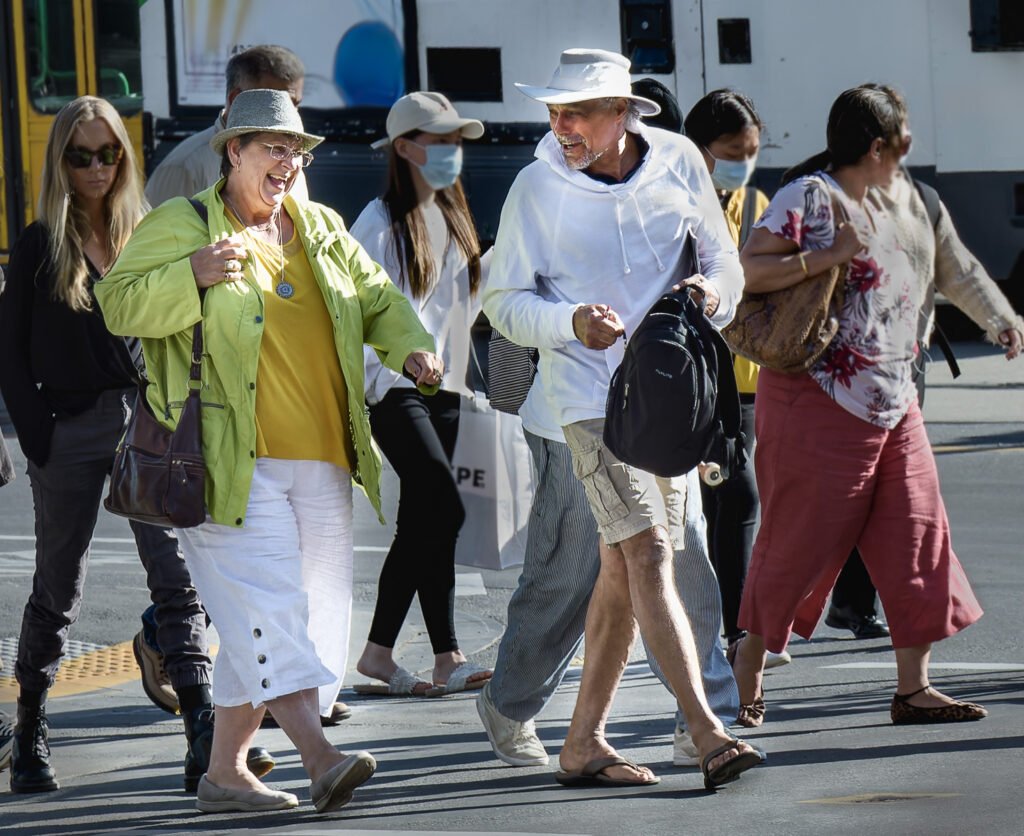
For me, the photograph above is one of those images.
It isn’t dramatic. It isn’t complex. It doesn’t do anything clever. It simply sits there, quietly, being what it is.
And in doing that, it allows something else to happen.
You notice the expression.
The posture.
The moment held between words.
You start to sense the person, not the picture.
And every time I look at it, I feel a small, familiar response. Not excitement. Not admiration. Something gentler.
A sense of knowing.
It reminds me that humour can be a shield. That kindness often hides behind jokes. That people are more layered than they let on. That we all carry more than we show.
I don’t need ten images shouting different things at me.
I need one that understands.
Learning to Leave Space
It took me a while to get comfortable with empty walls.
For years, empty felt unfinished. Incomplete. Like something had been missed. I had an instinct to fill. To balance. To complete the picture.
If there was space, it meant something was lacking.
Or so I thought.
As I began removing images that no longer meant much to me, I noticed how uneasy that made me at first. The gaps felt exposed. The rooms felt quieter. Almost too quiet.
And then, slowly, something else happened.
The space began to breathe.
Without competition, the remaining images settled. They had room to exist. Room to be themselves. Room to be noticed. I found myself looking at them differently, not because they were better, but because they were no longer crowded.
I realised I had been treating my walls the same way many of us treat our lives.
Filling every gap.
Occupying every space.
Leaving no room for pause.
But presence needs space.
An honest image needs air around it. It needs stillness. It needs the chance to be encountered, not just passed.
When you live with fewer images, you don’t skim. You sit. You notice. You return.
You form a relationship.
And that relationship deepens, not through novelty, but through familiarity.
I hadn’t expected that.
I had assumed more would give me more. More interest. More stimulation. More to engage with.
What I found instead was that less gave me more.
More quiet.
More depth.
More room to feel.
And once I felt that, I didn’t want to crowd it out again.
The Quiet That Follows
There is a particular kind of calm that only arrives when you stop trying to fill every space.
Not the calm of neatness.
Not the calm of order.
The calm of enough.
I didn’t recognise it at first. I thought the rooms felt empty. Sparse. Unfinished. It took time to understand that what I was feeling wasn’t absence, but stillness.
The noise had gone.
Without multiple images competing for attention, the space softened. The light had somewhere to land. The eye had somewhere to rest. The room stopped asking to be looked at and started allowing itself to be lived in.
And in that quiet, something unexpected happened.
I became more aware of myself.
Of how I moved through the space.
Of where I lingered.
Of what I noticed.
When there is less to absorb, you absorb more.
The remaining images didn’t feel lonely. They felt deliberate. Considered. Chosen. And that difference mattered. It changed the tone of the room. It changed the way I felt in it.
I realised I had been confusing fullness with richness.
They are not the same thing.
A wall can be full and still feel thin.
A room can be busy and still feel hollow.
Simplicity, I’ve learned, has weight. It carries intention. It signals care. It suggests that what is present is there for a reason.
And that, quietly, brings a different kind of peace.
Not because there is less.
But because what remains is true.
What Grows When You Stay
There is something that happens when you live with an image for a long time.
Not weeks.
Not months.
Years.
The initial reaction fades. The novelty goes. The sense of newness disappears. And what remains is something else entirely.
Familiarity.
At first, I thought that meant interest would fade. That I would stop seeing it. That it would become part of the background, like the other images once had.
But the opposite happened.
The more I lived with it, the more it revealed.
I started noticing details I hadn’t seen before. The tilt of the head. The pause in the expression. The small, human hesitations held in the frame. The space between what is shown and what is suggested.
It didn’t grow louder.
It grew deeper.
Some days, it feels light. Almost playful.
Some days, it feels reflective.
Some days, it feels quietly sad.
The image doesn’t change.
I do.
And that’s the point.
An honest photograph is not a fixed thing. It meets you where you are. It reflects back what you’re carrying. It shifts as you shift. It becomes less about what is in the frame and more about what it stirs.
I’ve realised that when you live with many images, you skim them.
When you live with one, you enter it.
It becomes part of the rhythm of the house. Part of the emotional landscape. Part of the way the room holds you.
It stops being decoration.
It becomes a companion.
And that, I’ve learned, is something worth making space for.
When Honest Becomes Enough
Somewhere along the way, impressive lost its shine.
Not because it stopped being impressive.
But because it stopped being enough.
I still appreciate skill. Craft. Ambition. The ability to make something striking. I haven’t lost any of that. But I’ve learned that admiration is a thin emotion to live with.
It doesn’t last.
It flares, and then it fades.
Honest is different.
Honest doesn’t need attention.
It doesn’t demand recognition.
It doesn’t care who is watching.
It simply is.
And that has begun to matter more to me than almost anything else.
Not just in art. In life.
I’ve spent years being capable. Dependable. Presentable. Doing what needed to be done, when it needed to be done. That was necessary. That was useful. That was right for the season I was in.
But I’m in a different season now.
One where I’m less interested in looking the part and more interested in being it. Less concerned with how things appear and more attuned to how they feel. Less inclined to collect and more inclined to keep.
One honest photograph does that for me.
It doesn’t impress.
It doesn’t perform.
It doesn’t compete.
It simply sits there, quietly, knowing what it knows.
And somehow, that’s enough.
I don’t need my walls to be interesting.
I need them to be true.