
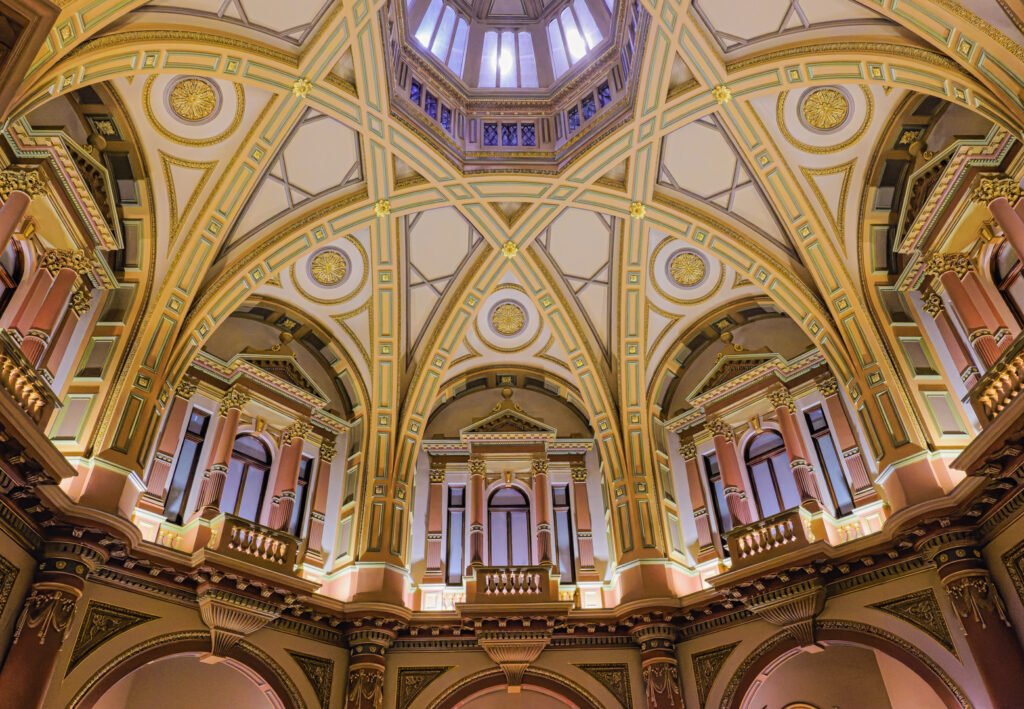
I’ve been thinking about the way our spaces quietly shape us.
There is a particular kind of beauty that leaves no trace.
You see it in hotel lobbies, corporate foyers, display apartments. Perfect lines. Polished surfaces. Carefully balanced colours. Everything in the right place. Nothing out of place.
And yet, nothing stays with you.
I took the photograph above on a recent visit to Melbourne. It wasn’t a new building to me. About thirty years ago, I attended a business meeting there. I remember rushing in, focused on being on time, barely registering the space around me. The building was simply a backdrop to the task at hand.
But something about it stayed.
Not clearly. Not consciously. Just a faint impression that surfaced years later, unexpectedly, and quietly insisted on being revisited.
So this time, I went back. Not as someone hurrying through, but as someone paying attention.
The light was clean. The geometry was strong. The building did exactly what it was designed to do. It impressed. It dominated. It stood, solid and self-contained.
What it didn’t do was speak.
There was no warmth in it. No story. No sense that anyone had ever leaned against it, waited by it, or carried something heavy past it. It was beautiful in the way that objects can be beautiful. And empty in the way that objects often are.
Over time, I’ve noticed how often we do this in our own homes.
We choose art because it “works with the room.”
Because it matches the sofa.
Because it fills the space.
Because it looks safe.
We curate, coordinate, and complete. And then we sit in these rooms and feel… oddly untouched by them.
Nothing is wrong. And yet something is missing.
It isn’t more colour.
It isn’t better framing.
It isn’t a larger canvas.
It’s us.
Somewhere along the way, art stopped being about connection and started being about compatibility. It became another design element. Another box to tick. Another surface to finish.
And in doing that, we quietly removed the very thing art is meant to bring into a space.
A human presence.
Most of us don’t set out to make our homes feel empty.
We don’t wake up and think, “Today I will choose something meaningless and hang it on my wall.”
It happens slowly. Quietly. Reasonably.
For me, it began years ago, during the busiest stretch of my working life. Long days. Tight schedules. Too many meetings stacked too closely together. Home was where I recovered, not where I reflected.
When we moved or redecorated, the walls were bare, and the rooms felt unfinished. So we filled them. Prints that were pleasant. Landscapes that were safe. Pieces that didn’t ask questions and didn’t require answers.
They looked fine. They still do.
At the time, that was enough.
I didn’t want to think when I got home. I wanted the day to stop. I wanted the noise to settle. I wasn’t looking for meaning on the walls. I was looking for rest.
So we chose what worked. What matched. What wouldn’t clash or challenge. What the catalogues said belonged.
And then we lived with it.
We walked past it every day. We stopped noticing it. It became part of the background, like the light switch or the skirting board. It did its job. It filled the space.
But it didn’t speak.
If I’m honest, I didn’t expect it to.
The strange thing is, I didn’t notice what was missing until much later in life, when life slowed down enough for me to actually be present in my own rooms. When I started sitting instead of rushing. Looking instead of passing through.
That’s when the quietness started to feel less like calm and more like absence.
Not wrong. Just… thin.
Rooms that were styled, but not inhabited.
Walls that were filled, but not known.
It wasn’t that there was anything wrong with them.
It was that there was nothing of me in them.
Every now and then, something slips through the filter.
It isn’t planned. It isn’t strategic. It doesn’t arrive because it matches the cushions or completes the palette. It just… stays with you.
For me, this began to happen when I started taking photography seriously. Not as a hobby. Not as something to do. But as a way of paying attention.
I would come home from a shoot and sit with an image longer than I needed to. Not editing. Not analysing. Just looking. Letting it sit.
Some images I admired. Some I respected. And some… lingered.
They reminded me of places I’d been without realising they mattered. Of moods I hadn’t named. Of parts of myself I hadn’t given much space to.
One image in particular stayed with me for weeks. I didn’t think it would work in the house. I didn’t think it quite “went.” I wasn’t even sure why it mattered.
But I kept opening it. Kept returning to it. Kept feeling something settle when I looked at it.
So eventually, I printed it. Framed it. Hung it.
At first, it felt exposed. Too personal. Like I had put something private on display. It didn’t blend in. It didn’t disappear. It had a presence.
I noticed it.
I looked at it.
I registered it.
And then something quietly changed.
The room started to feel less like a space we had arranged and more like a place we actually occupied. The wall stopped being a surface and started being a holder.
Of memory.
Of mood.
Of something real.
I didn’t walk past it. I acknowledged it.
It didn’t just fill the space. It kept it.
And without quite realising it, I started feeling more at home.
Not because the room looked better.
But because it felt truer.
Most of us don’t avoid meaningful art because we don’t care.
We avoid it because it asks something of us.
For a long time, I didn’t want my walls asking me questions. I spent years in structured environments, measured outcomes, deadlines, agendas. My working life was about clarity, precision, and control. At the end of the day, I wanted simplicity. I wanted things to behave.
Neutral images behaved.
They didn’t stir anything.
They didn’t remind me of anything.
They didn’t ask me to feel.
They were there, and that was enough.
Looking back, I can see that I wasn’t choosing art. I was choosing quiet. Not the nourishing kind, but the kind that comes from keeping things at arm’s length. The kind that doesn’t disturb the surface.
A neutral image doesn’t reveal much.
A generic landscape doesn’t say much.
A well-coordinated print doesn’t give anything away.
It’s safe.
It lets us keep our private lives private. It lets us maintain the quiet fiction that our homes are just spaces, not reflections. That what we carry doesn’t need somewhere to land.
But when you choose something that actually matters to you, you are, in a small way, letting yourself be seen.
Even if no one else ever notices.
Even if no one else ever asks.
You will know.
And for someone who has spent a lifetime being competent, reliable, and composed, that can feel oddly vulnerable. Exposing, even.
There is also the fear of getting it wrong. Of choosing something that feels right today and different tomorrow. Of committing to an emotion instead of a look. Of trusting yourself instead of the catalogue.
I felt that. Strongly.
So I defaulted to what was easy.
What was proven.
What had already been approved by someone else.
Not because I lacked taste, but because I didn’t yet trust my own.
And in doing that, I quietly kept my inner life off the walls.
The strange thing is, we usually know when something belongs.
Not logically. Not analytically. But immediately.
For me, this started in small, almost unremarkable ways. An image I couldn’t scroll past. A photograph that kept pulling me back. A scene that felt oddly familiar even when it wasn’t.
I would tell myself it was just good composition. Or interesting light. Or clever technique.
But if I’m honest, it was never about that.
It was about recognition.
About something in the image touching something in me.
Sometimes it was a place that reminded me of travel and freedom. Sometimes it was a face that carried a kind of quiet endurance I recognised. Sometimes it was an empty space that felt peaceful instead of lonely.
These weren’t dramatic reactions. They were private ones.
A soft tightening in the chest.
A sense of ease.
A small internal nod.
And I learned how easily I could override them.
With logic. With practicality. With “that won’t work here” and “that’s not really our style” and “I’ll find something better.”
But the images that stayed with me were rarely the ones that looked best in the room. They were the ones that felt like they already knew me. Like they had found a place I hadn’t quite named.
Over time, I stopped asking, “Does this suit the space?”
And started asking, “Why am I drawn to this?”
That single shift changed everything.
Because when you choose an image that speaks to you, the room doesn’t just gain a feature. It gains a layer. A depth. A quiet companion.
It stops being a backdrop.
It becomes a participant.
And that’s when a house begins, very gently, to feel like a home.
A home doesn’t need to be dramatic to be meaningful.
It doesn’t need bold statements or clever concepts. It doesn’t need to impress visitors or explain itself. It simply needs to feel inhabited. Known. Lived in.
When the images on your walls carry something of you, the room changes in ways that are hard to measure and easy to feel. It becomes quieter. Warmer. More settled. Not because it is better designed, but because it is more honest.
You stop decorating and start belonging.
The space begins to hold you instead of the other way around.
This is not about having more.
It is not about spending more.
It is not about getting it “right.”
It is about allowing your inner life to have a place in the outer one.
About letting memory, identity, longing, humour, loss, hope, and history quietly take their place on the wall.
About choosing images that don’t just fill space, but keep it.
And when you do that, something subtle but important happens.
Your home stops being a backdrop.
It becomes a witness.
To who you are.
To where you’ve been.
To what matters.
And in that, the space you live in becomes more than arranged.
It becomes yours.
If you’re curious, this way of seeing is what shapes my own photography. I’m drawn to quiet moments, human stories, and the spaces where memory and imagination overlap. I make images for people who don’t just want something on their wall, but something that belongs there.