
There are photographs that impress us immediately.
Perfect light. Perfect composition. Perfect timing.
And then there are photographs that stay with us for reasons that are harder to explain.
Not because they are spectacular.
Because they feel true.
The older I get, the more I find myself drawn toward those photographs.
Not the ones trying hardest to become important.
The quieter ones.
The imperfect ones.
The ones that seem less interested in being admired than simply being seen.
A photograph can be technically excellent and still feel emotionally distant.
Another can be grainy, awkwardly framed, or taken in difficult light and somehow feel more human.
More believable.
More honest.
I think part of that honesty comes from restraint.
Some photographs do not force meaning onto the viewer. They do not tell us exactly what to feel. They simply leave space for recognition.
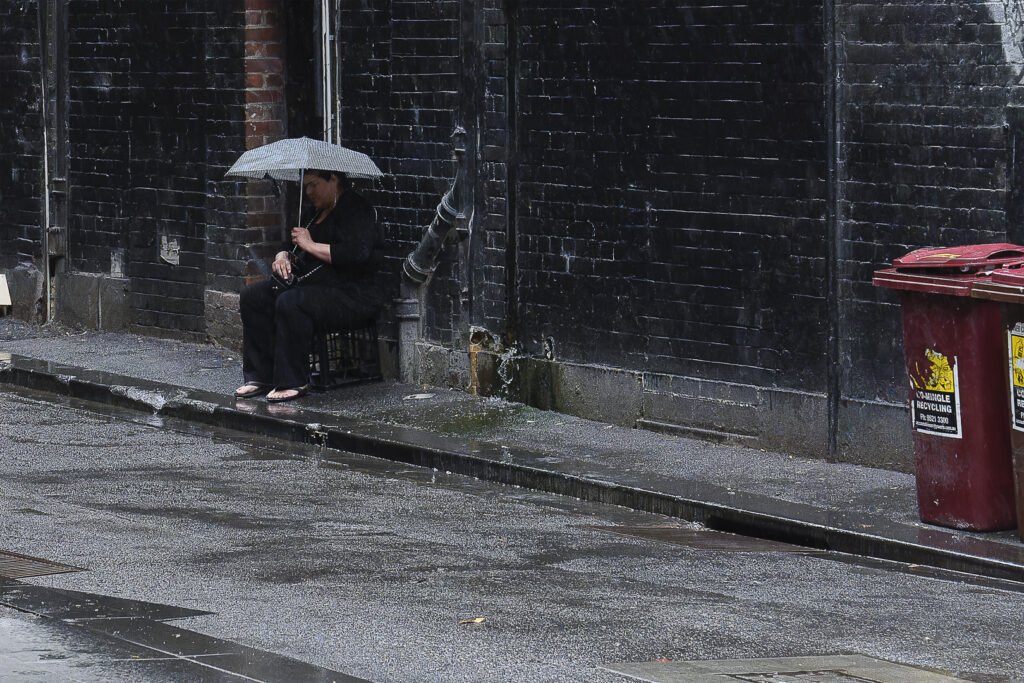
A woman sitting in the rain beneath a small umbrella.
An older man alone at a picnic table looking down at his phone.
Someone standing silently at the edge of the ocean while the weather turns rough.
None of these moments announce themselves as important.
That may be precisely why they feel important later.
The camera often reveals the difference between observation and performance.
Some images feel constructed around the idea of being photographed.
Others feel as though the photographer simply noticed something and quietly allowed it to exist.
I trust those photographs more.
Not because they are objective. No photograph truly is.
Every photograph contains choices:
where to stand,
when to press the shutter,
what to include,
what to leave outside the frame.
But honesty in photography is not about neutrality.
It is about emotional sincerity.
A photograph feels honest when it does not seem to be hiding from reality.
That reality might be loneliness.
Or uncertainty.
Or exhaustion.
Or tenderness.
Or simply the strange silence that exists between people in ordinary moments.
The photographs that feel most honest to me are rarely dramatic.
Often they contain hesitation instead of certainty.
Distance instead of clarity.
Questions instead of conclusions.
Sometimes honesty appears through imperfection.
Harsh weather.
Flat light.
Empty space.
An awkward gesture.
A moment that arrives half-finished.
Those things can make a photograph feel more believable because life itself rarely arrives perfectly composed.
We spend so much time surrounded by polished images now that honesty has become visually unfamiliar.
Everything is edited toward certainty.
Toward clarity.
Toward instant emotional readability.
But real moments are often quieter than that.
More unresolved.
A truly honest photograph sometimes leaves us unsure what we are looking at emotionally.
That uncertainty can feel deeply human.
I have photographs in my archive that are technically stronger than others.
Sharper.
Cleaner.
More dramatic.
Yet when I revisit old folders, it is often the quieter photographs that continue to hold my attention.
Not because they explain something.
Because they remember something.
A mood.
A passing feeling.
A small human truth that would otherwise have disappeared unnoticed.
Perhaps that is why some photographs endure while others fade.
Not because they were louder.
Because they were honest enough to trust silence.
I write and create around presence, time, and the quieter ways we live with images. If this resonated, you may find similar reflections in my photography.